Throughout the duration of the class TRF-2820, I had learned many things that not only solved significant problems on my course, but also contributed highly to my knowledge in the future of my turfgrass career.
The assignment we had to do on weed ecology helped solve the issue we have been having with Barley Foxtail on our course. I was able to execute a plan that showed significant results in controlling the foxtail. With the success of the assignment, I was able to use the methods that were used in the project on other areas of my course, which resulted in the control of a lot of the Barley Foxtail on our course.
Before and after project. Drag slider to see the difference
I believe the most useful goal in this class to my future work was the reclamation goal. Because of this goal I learned to always check every type of parameter before beginning a project on your course. In this assignment, I forgot to check the soil composition before reseeding an area, this resulted in little to no growth of turf because the seed was growing on mostly clay. That could have been avoided and the area could have been resurfaced properly beforehand if I had checked the soil composition first.
A plug I took after weeks of no growth. Shows the composition is mostly clay.
I do believe that the content and format of assignments align well with work expectations and work schedule, especially when you have the freedom to pick and choose which assignments you want to do in whatever order. This gave the freedom to be able to pick projects when they worked best for you. This season has been extremely busy with my new position and a lot of added stress, but having the freedom to be able to hand in the projects at my own pace really helped me succeed.
I believe that TRF-2820 was a very knowledgeable and interesting class that highly contributed to my learning of turfgrass science and will help me with my success as a turfgrass manager.
In the last few weeks of TRF-2810, I have had the opportunity to lean lots not only from this class, but in the industry as well due to my mentor resigning and my co-worker and I taking the reigns of the golf course. In this class, we have been working on a spreadsheet that allows us to grade our greens both with visuals, as well as outside factors that could affect the turf. The visual factors ranged from the colour of the turf itself, to disease identification. Whereas the outside factors ranged from sun and wind exposure, all the way to entry and exit points.
In my personal opinion, I believe this project was extremely beneficial to my knowledge on turfgrass and will keep me researching into issues that may arise instead of relying on someone else to tell me what to do. Especially with this unexpected jump in my position on the golf course. I find using this guide will allow me to dig deeper into issues that may occur on a golf green. For example, when it comes to the colour of the turf itself, if I notice a discolour of the turf, that’s going to raise suspicion and require me to do some research in what the colour is telling me, it may be telling me I’m low on macro or micro nutrients, it may be telling me that there is now a disease present that needs to be taken care of. This also goes hand to hand with outside factors, if I know that my greens have seen lots of wind and sun that day or week, I will need to compensate that with a bit more irrigation, or if I notice that my greens are looking a bit dryer, it may require me to look back into my records and check when the last wetting agent went down to see if I need to put one down.
I will be carrying this document with me for the rest of my days as a turfgrass specialist, as I see it as a huge benefit to have. Like mentioned above, it’ll keep records of what was graded previously, which will trigger an alarm if something seems out of place and needs to be taken care of. I find it will be extremely beneficial in this profession to keep you knowing what your greens have been rated in the past and how you actually dealt with a lower grade so you can use that as a reference to deal with an issue that may arise again.
In the last two weeks of TRF-2740, I have had the opportunity to learn absolutely critical knowledge through the various assignments that I will carry with me through my journey of becoming a superintendent. The assignments varied from discovering our individual courses mission statements, learning how to build and create a golf course etiquette for the maintenance department, all the way to having a full-on board meeting with the class acting as members. All the lessons we learned came together in the end to create an employee handbook that would be live and ready to use in the field for our individual golf courses. The projects we completed were absolutely phenomenal in broadening my mind in the management side of turfgrass management.
The two projects that most influenced my knowledge in the turfgrass community were the rules of golf and the etiquette for golf course maintenance. The golf course rule project was extremely helpful in showing me the wide variety of rules the game of golf has and how much golf pros need to know these rules in order to do their job, not only that but it really opened my eyes to the different jobs a pro actually goes through during a daily shift. It really gave me a new level of respect for the golf pros. For the golf course etiquette, I really enjoyed seeing how the class all had different views and thoughts on how the different etiquettes of a golf course should be seen.
I will definitely be using all this information and knowledge I’ve gained in this class everyday in my golf course career. I will especially be using the employee handbook and revising it as often as possible to ensure it is updated always, especially if I move to a new course and the mission statement, core standards, BMP’s, etiquette’s and hierarchy are completely different.
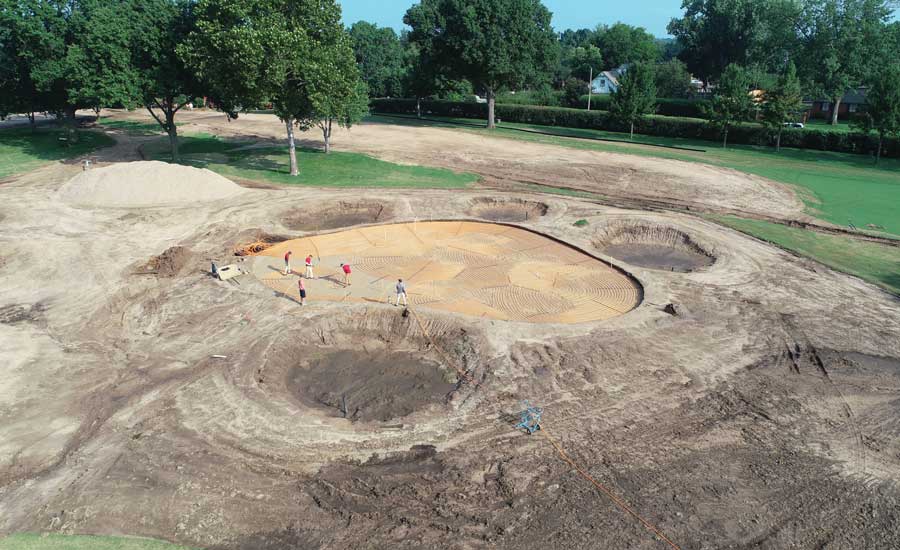
In the past few weeks of TRF-2730, I have had the opportunity to really explore new concepts of construction that were very interesting to me and really broadened my knowledge on turf construction. We started off by learning about the basic construction steps for golf course project. Which lead into doing a critical analysis on a golf course project, which lead into learning to read a topographic map and building nine holes on a map given to us, in final we had to create an entire green build using USGA specifications. Today I will be talking about the two lessons that I found the most interesting and also severely broadened my turf construction knowledge.
The first lesson is when we were tasked with choosing a golf course project proposal and doing an analysis on it. The group I was in decided to do our project on the Medicine Hat Golf and Country Clubs green resurfacing proposal. This assignment was extremely beneficial to allow us to see everything that would need to go into a proposal to the members or even a board or GM, it allowed us to pick apart the pros and cons of the entire proposal which in turn allowed us to see what we should and shouldn’t include in a proposal if we ever needed to make one.
This is an image of the cover page of the project proposal analysis my group submitted through moodle
The second lesson was learning how to read a topographic map. I believe this lesson was absolutely phenomenal and really broadened my knowledge. To start off we learned about all the proper terms for the different areas on the map, as well as learning how to calculate how much a slope is rising or lowering, also how to tell where the top of a hill is, where water sources will be, where streams will be, etc. This really will help if a project needs building such as a fairway reroute, a bunker project, a greens expansion; because with this knowledge, we should be able to read a topographic map and know where the undulations are, as well as knowing where we can and cannot put new areas especially If the course is located in a hilly/cliff environment.
This is an image of the Topographic map provided to us to create nine holes on. It was given to us through moodle
In the future, as mentioned in the paragraphs, I tend to use the knowledge I have learned from this class in the future when I become a superintendent. I can use the project we did on project proposals to tweak any proposals I may have in the future to favor the needs of the members and upper management. With the topographic maps, I tend to use if I need to complete a large project, as well to study the course I am dealing with to know every inch of the course and every undulation it has. Hopefully if my dream of building and running a golf course in the future comes true, having a topographic map in the future will give me a severe advantage on the placement of my holes.
In the last week and a half of TRF-2660, we have had to make extreme changes to our curriculum due to the Covid-19 outbreak, but this hasn’t stopped our class from pursuing our passion and continuing our learning of the Rainbird Cirrus software through Google meet. These past two weeks have been filled with tons of information I could add to my existing knowledge of irrigation software. I have been taught on Toro systems and how they work, but absolutely nowhere near the detail we have gone through in the past few days. We’ve gone through everything from learning how to run the program itself, to troubleshooting issues that we may run in to on the field.
Learning how to actually go into a system and manipulate it properly is absolutely phenomenal knowledge to have to not only make your irrigation run at optimum settings, but also having the ability to completely map out a golf course with zones, electrical (rotors), as well as laying out the hydraulic system as well. Having the ability to have a full-sized map in front of you and being able to see everything that is going on with your course irrigation wise is extremely beneficial information to have as a Turfgrass specialist. As I said above, having the ability to go into your system and make it so that its running irrigation as efficient as possible is super beneficial to not only the flow itself, but also for conserving water on courses that may not have the budget that high end courses have!
This is an image of a rainbird rotor, decoders and a solenoid. This was retrieved from https://www.rainbird.com/
In the future, I plan to take all of this knowledge with me on my journey to becoming a golf course superintendent. So that I can go into my system and monitor the efficiency at all times. I also now have the ability to be able to troubleshoot any problems we may have on the course without having to immediately go dig up a sprinkler head. I appreciate this entire class, auditing and software, not only for my golf course career, but also for my own personal benefit as I plan to irrigate my own lawn as well as a few family members, and the knowledge I’ve gained from TRF-1660 and TRF-2660 will aid me heavily whilst I undergo the process of irrigating the lawns.
In the first week of TRF-2660, I had the amazing opportunity to expand my existing knowledge on irrigation auditing. Coming into this class I had performed irrigation audits and catch can tests at the golf course I previously worked at before Serenity GC; although through this class, I found that the way I used to do it was extremely ununiform and in turn would give me inaccurate data.
The first day was a huge eye opener for me, although I knew how the process worked, I was now having to completely relearn how the test actually is supposed to be conducted. I never did the math to find the irrigation amount (IA) or precipitation rate as my past mentor and irrigation technician would deal with that once I finished the test. Now that I know and understand the math, as well as how to properly map out and lay catch cans, I believe that this will help me big time in the coming years of being a co-assistant to be able to determine the functionality and the efficiency of our irrigation and make changes if needed.
In the future when I become a superintendent. I plan to use this knowledge to make sure my irrigation is working the best it can and as water efficient as possible. This class has helped me in more ways then one, first in understanding the audit itself, as well as teaching me how absolutely important it is to have a properly working system. I also learned about how dangerous dead ends can be when it comes to building your initial system. I will take all of these lessons with me on my turfgrass journey.
In the last few weeks of TRF-2640 I have learned lots about how important it is to ensure golf courses are taking measures to become more environmentally friendly. Throughout this course my perspective on environmental stewardship has only opened my eyes more for the better. This class really showed me ways I can help improve the way the courses that I work at look at their environmental practices.
I believe that a program like the ACSP would be extremely manageable in my position given how important the environment is and how easy it is to become more friendly to the environment. I will definitely pursue the Audubon program now, especially knowing how easy it is to complete most of the tasks on the checklist. I believe the most important factor of driving Audubon certification for golf courses is the huge positive impact a golf course can be if it is properly maintained through an ASCP program.
The amount of benefits a golf course has for the environment is incredible. So, I believe if more golf courses use the Audubon program, a lot more people will stop biasing against golf courses and start golfing, which in turn will equal more golf courses to meet demand. The knowledge I have gained through this course I will take with me for the rest of my career when it comes to being more environmentally conscious.
In the last week and a bit of TRF-2420, through more case studies like we had done in the first week; I had the opportunity to further build my knowledge on turf disease identification, cultural practice timing, fungicide and fertility timing, as well as I also learnt a lot about budgeting. With these case studies I also was able to work on my presenting skills, which I believe was a huge takeaway from this class on its own.
On the first day of class we were given a task to create a seasonal plan with the knowledge our groups had, we all had believed that we were close to getting our plans bang on. That was until we were given our final project and realized we had almost nothing at all. Our final project was to go back into the documents we created that first day and build onto the existing plan with the knowledge we have gained over this course. So immediately our group opened up the existing document and started building more and more onto it, such as planning all of our events and cultural practices, as well as our fertility program. Every aspect of the golf course we could think of we went as far into depth as our knowledge would take us and the amount of information that we had missed was actually eye opening. We ended up adding over double the amount of content to what originally had been there. This really showed me how beneficial this class has been to my knowledge of turf and golf course management.
With that being said, I plan to bring all the knowledge I have learned over this course and continue to build on it through my journey as a turf grass professional. Especially the lessons I learned on budgeting and planning, as well as the amount I learned about seasonal diseases on turfgrass. This class has been phenomenal and I’m excited to see what next block brings.
For the first week of TRF 2420, we were given two case studies in which we had to solve within our group. These assignments consisted of a winter and summer disease and as new superintendents we had to diagnose, repair and prevent these diseases from occurring again. We were then to present these diseases to our board (class) and propose how we were going to fix the problem and keep it from happening the following season.
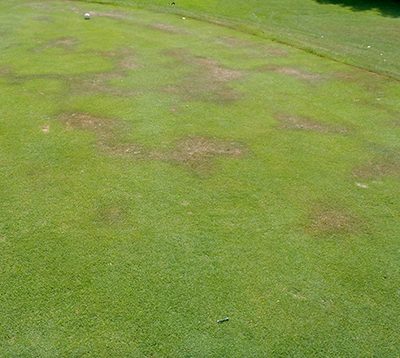
The first case study was about a winter disease. Our group was given a scenario where when we pulled off the tarps from six greens, we found approximately 2000 ft2 of large areas of straw-coloured turf, especially on ridges and high spots. We had been told that the winter had been full of chinooks and strong winds, so from that information and from our research, as well as process of elimination of other diseases; we were able to come to the conclusion that the disease was winter desiccation. Now knowing what the disease was we were able to research how to repair and prevent this disease and build a presentation to show the board. (A photo of winter desiccation is below, the photo was provided by our course)
For the second case study we were given a different course that had a summer disease. This course had an issue in which they found spots of brown spots in weird shapes and patterns on their greens and we know its not dry spots as there was a wetting agent sprayed a week prior. Using the conditions of the course that were given to us and process of elimination of other diseases we came to the conclusion that it was take-all patch. Now again, we could research and present to the board once again. For this assignment though, there was a bit of a change. Every member of the group was told we could be called upon to present. I found this to be very beneficial because ever member of the group had to know the information and be on their toes and ready to present. This is something I have never seen before and are looking forward to more of it in the future. (Picture of take-all below, this photo was provided by the course)
I believe this week has taught me many things that I can use to benefit myself in becoming a superintendent. Not only has it taught me lots about identifying, preventing and repairing numerous diseases that can occur on a golf course, but it has also taught me a lot more about being prepared for presentations. When you’re prepared for a presentation the information just flows out of your mouth and it makes talking in front of numerous people a lot easier.
Over the duration of this golf season, I have had the opportunity to greatly advance my turfgrass knowledge through the field school course TRF-1760. This class included three assignments that hugely contributed to my interest in the industry. The first assignment was focused on turf characteristics and we were to identify the major species of turfgrass that resided on our individual courses. This project helped me to understand why certain grasses are used in specific areas; like how fescues are typically used in less irrigated areas for the fact that they are typically drought resistant, or how bentgrass is typically used on greens for its ability to be mowed to extremely low lengths and for the reason that the grass naturally bends to allow for a more consistent ball roll.
This is a photograph I had taken of Lolium perenne (Perennial ryegrass) which shows the bunch type growth habit and purple sheath.
The second assignment was on physical land characteristics and we were to determine which site characteristics affect the ability of playing conditions by comparing the easiest to the hardest hole on our course of the same par. Through this project, I was able to realize how detrimental the characteristics of a course is for playability, from the tee box size and position to the undulations of a green, all the way to the shape and size of your fairways; no matter the area on the course, the characteristics were all planned out to keep playability consistent throughout the course.
This is an image taken during the land characteristics class, it shows the difference in pin positions with the changing green undulations.
The third assignment was all about client demographics and we were to figure out how client’s desires dictate the playing conditions on a course and how to know if you are meeting or exceeding said client’s expectations. This project really opened my eyes to how important it is to consider your members wants and desires for the playability of a course. If you take in member requests, not only will you satisfy the existing members you already have, but word travels fast through the golf world which could potentially increase your clientele.
This is an image taken after I had completed rolling number twelve green after numerous member requests to speed the greens up a bit for the day
After all of these assignments, if I were to choose which one has a larger influence on playing conditions, it would be the second assignment on physical land characteristics. In my opinion, I believe that the characteristics are the base of all playing conditions. Without the physical characteristics of a golf course you can’t even begin to think about the turf characteristics or client demographics. The type of grass used on a course all depends on how the course was built. The areas of a course have to be dictated before any growing in can commence; you wouldn’t just throw out seed and sod onto a course without first knowing where it is all supposed to go. The reason for it being above client demographics is the fact that you need to have a course built and land characteristics planned before even having any type of clientele to take suggestions from. Although all the classes taken over this season are important in sustaining a golf course, these are my reasons and opinions on why I believe physical land characteristics are more important to playing conditions on a golf course than any of the other lessons learned.
So, are these assignments interconnected to one another? In my opinion, they definitely are. Oddly enough, throughout the duration of the second assignment, I had a conversation with my wife about how the two projects were looking like they were connected to one another. This was noticed during my research, as I had seen that the physical land characteristics can have a huge influence on the turf characteristics that are used in certain areas on a course. For example; in areas such as the turf surrounding a bunker, or the turf that is grown into the tall rough such as fescues, you’re going to want a species that is less dependent on water and doesn’t require heavy amounts of maintenance to keep your labour costs down and to ensure the grass doesn’t die if it doesn’t have much attention paid to it. This all would have been planned and executed in the building of the physical land characteristics. When it comes to client demographics, I believe this is extremely interconnected because of member feedback. If you are having many members approaching you about a problem, the likely cause of their problem is going to be the physical land characteristics. Whether it’s the way the pin was set that day, or the way the tee boxes have been looking lately, or even that the greens aren’t playing as well and are extremely inconsistent. This can all be due to the type of grass used as well. When it comes to turf characteristics, in your initial planning you could have thought that using Poa annua on your greens was a better bet, but when the members start complaining about the quality of their game you may look at changing the type of turf you are using to Agrostis stolonifera to better suit the needs of your members (if your budget allows for it). I believe that these are all interconnected through not only the turf itself, but also through the quality of work and planning that goes into building the course in the first place.
This is an image of hole number thirteen of Dancing Bull at Serenity, it is the most difficult hole on the course. It shows the aspect of the land characteristics and turf characteristics.
All of these assignments were meant to open our eyes as to how important playing conditions are whilst running a golf course. In my opinion, I don’t believe any of these assignments are more important than the others. I believe they are all important together, because without one the others would fail. Without properly planned and thought out land characteristics, the course would be super inconsistent and lacking proper maintenance, likely angering any golfer that dares to play the course. Wiithout client demographics, there would be no feedback on the way your course plays, so there would be no changes to fit golfers needs, therefore your course would never improve and likely fail. Lastly, without turf characteristics, there wouldn’t be a golf course to play on at all, you would be playing golf off of soil mounds. So with that being said, I truly don’t believe any one of these assignments outshines another and I don’t believe they run in any type of sequence either, in my opinion I believe they happen continuously on a day to day basis because, as originally stated, you need them all in order to run and maintain a successful golf industry. Without one of these practices, your entire course would fail.
In conclusion, these assignments have not only strengthened my love for turfgrass science, but they also greatly improved my knowledge on the topic as well. The lessons I have learned from them I will take with me throughout my path to becoming a superintendent. Once I become a superintendent I will be able to use these projects and lessons to better run my course. Knowing these three things need each other to keep a golf course running will be detrimental to being a successful golf course leader. Taking in suggestions and doing your best to satisfy the needs of golfers is a huge way to keep clientele and bring in more. By making sure your courses land characteristics stay fair for all handicaps and skill levels contributes to keeping these clients happy and of course the type of turf used plays a huge roll in the difficulty of not only the game itself, but maintaining the course as well. I believe all of these assignments are extremely interconnected and rely on each other to keep your golf course healthy and running smooth.








 Kenden Backhouse's Turfgrass Blog